Christian Huff
CFO

Why providers of automation and robotics need a sales driven website and dedicated landing pages per use case, and how that turns complex systems into qualified inquiries.
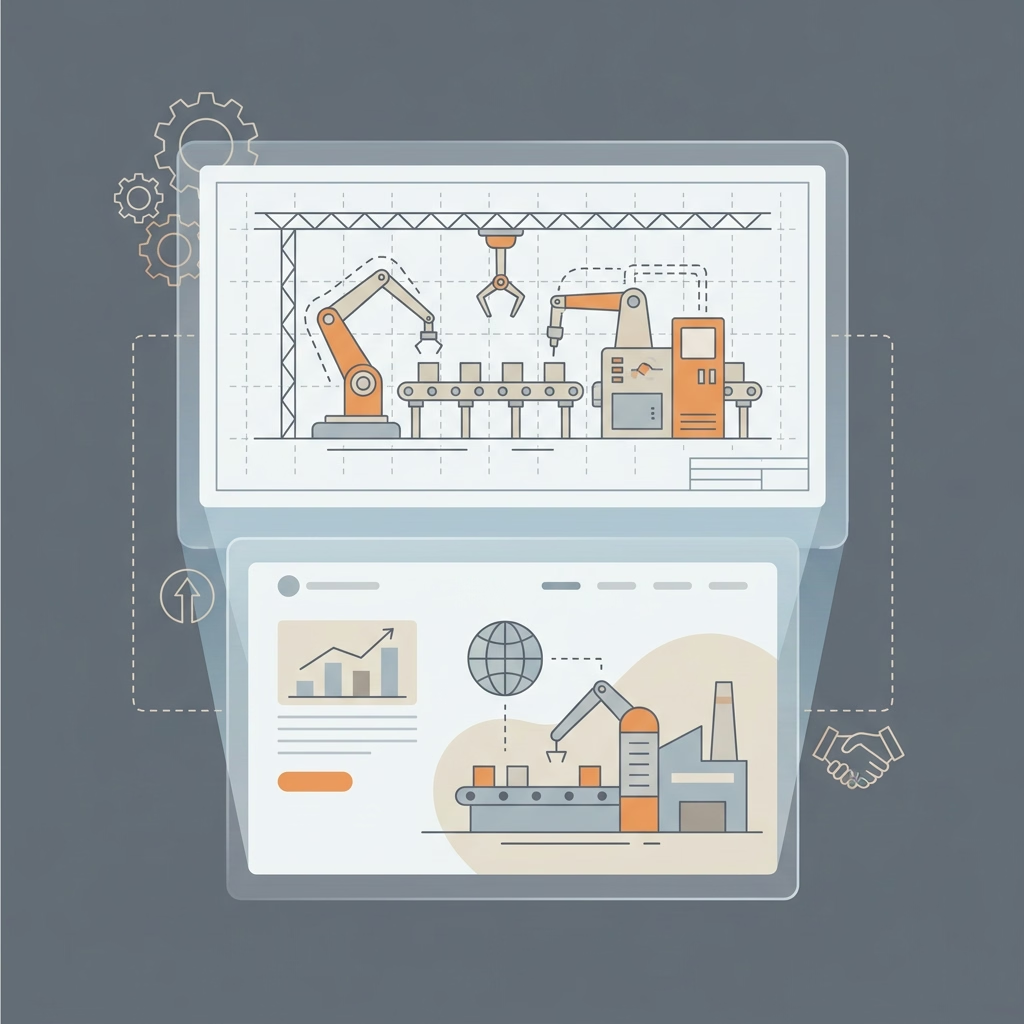
A website for automation and robotics has to do something few other industries demand this sharply: it has to make a complex system that needs explaining understandable, and at the same time build trust for a large investment. Anyone offering a robot cell, an automated assembly line or a turnkey system rarely sells off the shelf. Yet this demanding offering often ends up online as a wall of spec sheets, from which a prospect cannot read the actual value. This article continues our series on the sales driven website in machine building.
Projects in this segment are high value, technically deep and rarely the decision of a single person. On the customer side several people usually evaluate in parallel: the technical lead assesses feasibility and interfaces, management or procurement assesses the investment. The buying process runs over weeks to months, and it almost always starts with research. Anyone who is not visible and convincing there drops out of the shortlist before the first conversation even happens.
Many providers believe they mainly need a more modern look. That falls short. The more common problem is that the technical depth never becomes visible online. Nice images without substance convince no engineer, and a mere list of specifications explains to no decision maker why the investment pays off. The result is long sales cycles, weak inquiry quality and projects lost to competitors who are not technically better, only better presented. How to translate engineering into a convincing story instead of listing features is shown in Storytelling Instead of Feature Lists.
Instead of forcing every solution onto a general product page, each relevant use case gets its own page. A page for the robotic welding cell addresses different questions than a page for an automated assembly line or a palletizing application.
Why such focused pages often decide more than the homepage is explained in Why the Services Page Is Underestimated.
The particular challenge in this segment: a good page has to serve two readings. The technical reviewer wants substance, meaning interfaces, performance data, integration capability and proof from comparable projects. The investment decision maker wants to know what result the system delivers, how the investment adds up and why the risk is manageable. A page that speaks only one of these languages loses the other side. Good landing pages bring both perspectives together without drowning one in the other.
Prospects in automation often search very specifically, for example for a particular robot application or the integration of a concrete system. For exactly these precise searches many providers are barely present online. That is an opportunity: whoever is visible for the specific questions of their target customers gets in touch early, often before the customer even knows the competitors. Visibility for the right search intent is therefore not a side stage but a direct sales lever.
This applies across machine building, but especially in the automation segment. Paid advertising brings in people who are searching for a specific solution. If they land on a general homepage, the message breaks and the paid click yields no inquiry. A matching landing page delivers what the ad promised, and it also makes advertising measurable: you can see per use case which campaign brings inquiries and which one only costs budget.
We first build the website as a sales instrument with clear positioning and a clean structure. On top of that we build dedicated landing pages per use case. The difference in the automation segment lies in the depth: where needed, we connect the site with our own software development, such as product configurators, the connection to a CRM system or clean multilingual support for international customers. Exactly these functions often decide the inquiry for technically complex products, and this is exactly where pure design agencies fail. The result is a page that makes technical strength visible instead of hiding it.
This article is part of our series on sales driven websites in machine building. The starting point is A Website for Machine Builders, and how the principle applies to special purpose machinery is shown in Special Purpose Machinery Online. The next articles cover further segments such as plant engineering, prototyping and maintenance.
As CFO, Christian is responsible for the business side of Iridium Works. Over the years, he has built and managed several companies. Christian writes about digitalization, sales, and current market trends, and how Iridium's services impact its customers.
Access our exclusive whitepapers, expert webinars, and in-depth articles on the latest breakthroughs and strategic implications of webdesign, software development and AI.