Christian Huff
CFO

A Recruiting-Magnet website replaces generic job listings with authentic storytelling about team, culture, and work, attracting candidates who already want to join before they see an open position.
The job posting went live on Monday morning.
By Tuesday, they had thirty applications. Sounds great, right?
By Wednesday, they'd screened all thirty. Two were serious candidates. The rest were from people looking for remote work who didn't read that the role was office-based. People who had no relevant experience but submitted anyway. People applying to every tech job they found because they were desperately searching. People who had no idea what the company actually did.
By Friday, both serious candidates had accepted offers from other companies. They'd been interviewing in parallel. The startup lost them during the waiting period.
This is the recruiting reality most companies face: they generate application volume but lose the people they actually want. And they blame it on a candidate shortage. On market conditions. On salary expectations being too high.
But look at their website. Look at their careers page. It tells you everything about why candidates don't commit.
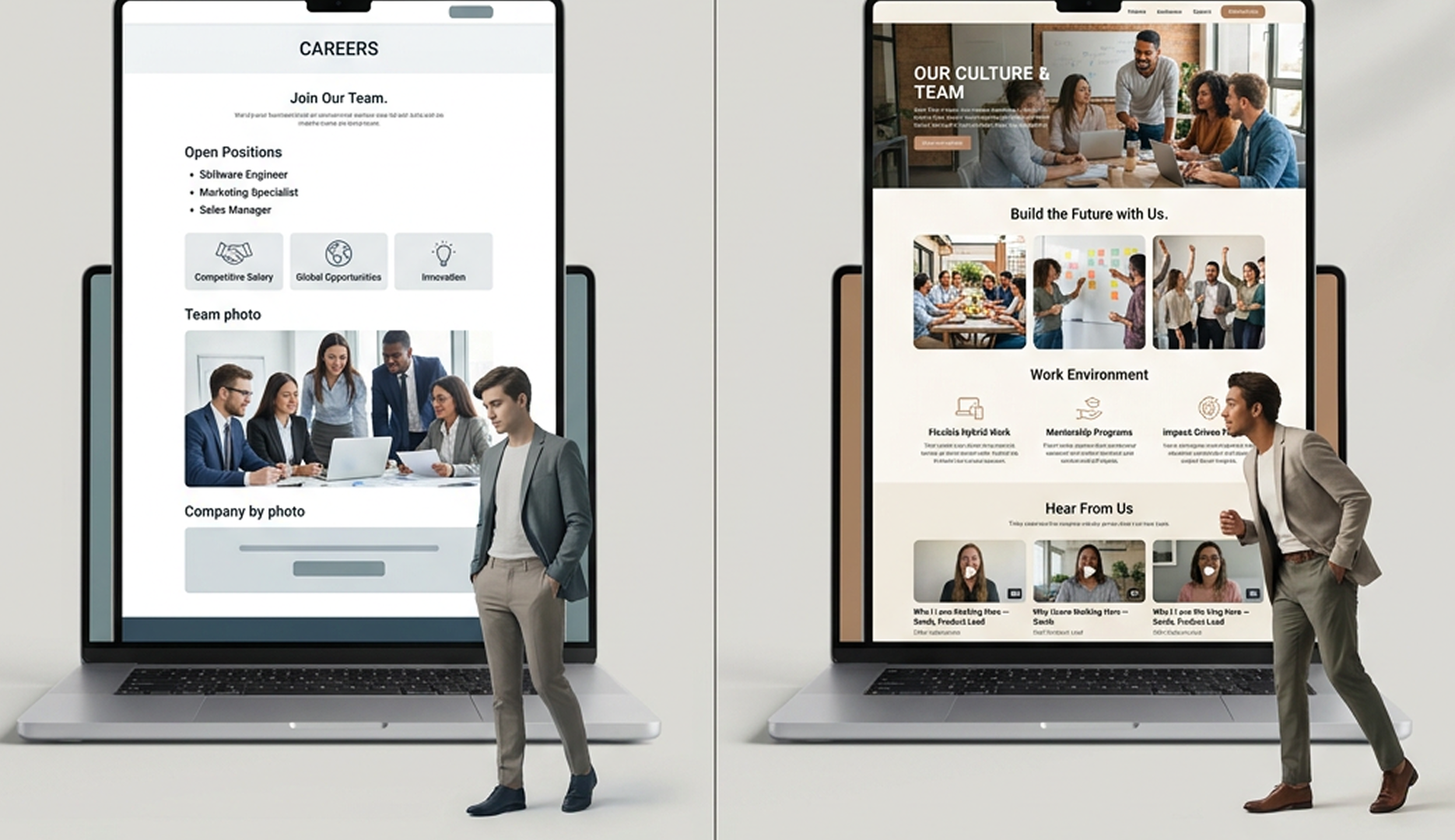
Most company websites treat recruiting as an afterthought. The careers page exists because it has to exist. It's a list of open positions with copy written by someone in HR who was given thirty minutes to fill it out. The company story? Not on the website. The culture? Communicated through vague benefits descriptions. What a day actually looks like? Nowhere to be found.
Candidates who are seriously considering joining a company need one thing: to believe they belong here and that being here matters.
Your website doesn't currently do that job. It does the opposite. It pushes them away.
This is where the Recruiting-Magnet archetype enters. It's one of the four website archetypes, and it solves a specific problem: how do you attract candidates who don't just apply for a position, but actively want to join the company?
The answer is not a better job board. It's not a recruiter with more hustle. It's a website that tells the real story of what working here is like.
Companies spend thousands on recruitment tools. They upgrade their ATS. They hire recruiters. They run LinkedIn Recruiter campaigns. They sponsor job posts on job boards. They do everything except the one thing that would actually work: make their website compelling enough that candidates choose them.
Here's what actually happens in a candidate's journey:
A developer sees your job post on LinkedIn. The title is interesting. The company name is vaguely familiar. They click through. They land on your website.
In those first thirty seconds, they're asking unspoken questions. What does this company actually do? Who works here? What's the culture like? Is this a real, stable company, or is it one that will implode in six months? Would I be proud to tell people I work here?
Your website currently gives them almost no answer to any of these questions.
If they're lucky, there's a team page with headshots and job titles. "Jane, Senior Engineer. Bob, Head of Product." No personality. No sense of who these people are or what they're actually like. Stock photography fills the rest of the site. The about page is a mission statement nobody wrote from the heart. The blog hasn't been updated in two years.
Within thirty seconds, they click away. The company feels generic. Risky. Not the kind of place where great people want to build their career.
Your competitors who have the same developer on their list probably have a different experience. They might have written a genuine post about their engineering culture. They might have case studies about the problems they're solving.
That candidate applies to your competitor instead.
This is not a talent shortage. This is a website problem.
Let's be specific about what's wrong with most careers pages.
You land on it, and here's what you see: "We're hiring for 8 positions right now." A list of open roles. Vague descriptions. A benefits section with stock descriptions: "Competitive salary. Health insurance. Flexible work arrangements. Growth opportunities."
Then maybe a "Meet the Team" section with headshots of 12 people smiling at the camera. No context. No story. No sense of personality.
If you're lucky, there's a quote from someone: "I love working here because the team is great and we work on cool problems." Not specific. Not memorable.
The whole page is designed to make the candidate submit an application, not to make them want to work there.
This approach comes from a misunderstanding of what recruiting is. Most companies think recruiting is about sourcing applications. But that's backwards. The best recruiting happens before the interview. It happens when a candidate has already decided they want to work for you, and they're applying to confirm what they already believe.
Your website needs to do that job.
A Recruiting-Magnet website answers the question: why would a great person want to work here?
Not through marketing copy. Through genuine storytelling.
A Recruiting-Magnet shows real team members doing real work. Not headshots. Not job titles. Real humans talking about what they actually do. Genuine conversations about what they learned here. Who mentored them. What problems they solved. What they'd tell a friend considering the company.
It tells the story of company culture not through claims ("we value collaboration") but through specifics. What does a typical day look like for an engineer? Walk through it. What happens in your decision-making meetings? Show it. How do you handle disagreement? Tell the story.
It's transparent about the application process itself. Transparency kills anxiety. Candidates know what to expect.
It includes content that makes candidates think "I want to work with these people." Blog posts about the problems you're solving. Technical writeups of interesting projects. Case studies that show real work and real impact.
Most importantly, a Recruiting-Magnet website acknowledges that the best candidates have options. They're not desperate for a job. They're choosing between opportunities. Your website needs to make it obvious why they should choose you.
There's a structure to this. Four elements separate you from everyone else.
Element 1: Authentic Team Presentation
This is not a headshot gallery. This is real people. Show them working. Show them in team contexts. Write about them. Not job title and biography. Story.
Who is the head of engineering? Write about their path to the company. What did they do before? Why did they join? What are they trying to build? You want a developer reading this to think: "That person seems interesting. I'd want to learn from them."
Better yet, do video. Short three to five minute videos of team members talking about their work. Not polished. Genuine. "Here's a project I shipped last quarter. Here's what I learned. Here's what I'd do differently." Real, imperfect, human.
The goal is for candidates to see personalities, not positions.
Element 2: Culture Through Specifics, Not Claims
Every company website says: "We have a great culture." This communicates nothing.
"Our engineers spend Fridays on learning and exploration. No sprints. No deadlines. You ship your own ideas." That's specific. A candidate reads that and thinks: "That's either amazing or terrible for me. I now have data to decide."
"Our CEO makes all salary decisions directly. Salaries are transparent. Everyone in the company knows what everyone makes." That's honesty about power dynamics.
Describe your culture in specifics, not aspirations. Describe how decisions actually get made. Describe what a Monday looks like. Describe what your first month on the job actually involves.
This filters beautifully. Candidates who want that kind of culture self-select in. Candidates who want something different self-select out. Everyone wins.
Element 3: The Application Process Explained Transparently
Most companies: a candidate applies, hears nothing for a week, then gets a vague phone screen email. No timeline. No clarity. The candidate keeps interviewing elsewhere and accepts another offer before yours arrives.
A Recruiting-Magnet explains the process upfront: "Our hiring process has four steps. First, a thirty-minute phone conversation with our hiring manager. Second, a four-hour take-home assignment. You get forty-eight hours. Third, a technical interview with two engineers. Fourth, a final conversation with our VP Engineering and CEO."
Include timeline too: "Each step happens within one week of the previous. If we move you forward, you'll hear from us within two business days."
Candidates respect clarity. They respect a process that respects their time. They're more likely to stay engaged because they understand what's happening.
Element 4: Content That Makes Candidates Think "I Want To Work With These People"
A Recruiting-Magnet is not just a careers page. It's a whole website that communicates what the company is about.
A candidate considering joining sees a blog post about "How We Reduced Our Deployment Time From One Hour To Five Minutes." They think: "These people are solving real problems. They care about shipping. I want to work here."
Another candidate sees a case study about a customer whose business grew 40% after implementing your product. They think: "The work we do matters. It has real impact."
Your entire website becomes a recruiting tool, not just the careers page.
A mid-market SaaS company in the project management space was struggling to hire engineers. Six months of open positions. All the typical tools: Indeed, LinkedIn Jobs, recruiters. Mostly junior developers from other countries or developers with completely wrong backgrounds applying to everything.
Their careers page: five open positions, benefits list, three headshots. That was it.
Here's what they changed: They replaced the vague benefits list with honest culture specifics. They documented what the engineering team actually does. They included a post from their VP Engineering about learning philosophy: "We hire for thinking ability, not experience."
They created short video clips of three engineers talking about why they work there. Not scripted. One talked about autonomy. One talked about working with a CEO who does code reviews. One talked about shipping real features customers use.
They wrote a technical blog post about a real project: "How We Built Our Performance Monitoring System." Engineering details. Code samples. Real.
They made the application process transparent. Every stage documented. Timeline clear.
Within three months: tripled their qualified applicant pool. Not total applicants. Qualified applicants. Offer acceptance rate went from 30% to 70%. Hiring time went from five months to two months.
They didn't change their salary. They didn't hire a better recruiter. They just told the truth about what it's actually like to work there.
Not every company should build a Recruiting-Magnet as their primary website archetype.
Some companies need to be a Kundenmagnet. They're selling services or products. Recruiting is secondary. But even those companies can integrate recruiting elements. Some of your best customers are the ones who also want to become employees.
Some companies are a pure Portfolio play. You're a creative agency or design studio. Yet even then, you can show your team and tell your culture story.
Some companies are a Recruiting-Magnet as their primary play. Think of a fast-growing startup where talent is your limiting factor. Your entire website becomes about attracting, filtering, and converting great people.
The mechanism is different from a Kundenmagnet, but the principle is the same: be clear, be authentic, be specific. Don't just list positions. Tell the story of what working here means.
Most companies spend 500 to 2,000 EUR per hire in recruiting costs. Plus the internal cost of hiring manager time. Your all-in cost per hire is probably 2,000 to 5,000 EUR or more.
The candidates coming through your website are usually higher quality. They've already decided they want to work for you. The offer acceptance rate is higher. The retention rate is higher. They arrive faster.
For a mid-market company hiring 20 people a year, shifting 30–40% of hires to website sourcing saves money and improves quality and speed across the board.
For a fast-growing startup where talent is the constraint, a Recruiting-Magnet website becomes a massive competitive advantage. You're not fighting everyone else for recruiter attention. You're attracting people directly.
1. Document your culture in specifics. Not values. Specifics. How do decisions actually get made? What does a typical week look like? What's hard about working here? What's great?
2. Film your team. Short videos, three to five minutes each. Three to five people. Let them talk about their work, their journey, what they'd tell a friend. No scripts. Keep it real.
3. Write content about your work. Blog posts, case studies, technical writeups. Prove that interesting problems get solved here.
4. Make your application process transparent. Document every stage. Give timelines. Respect candidates' time.
5. Test your careers page with an outsider. Can they answer: What do you do? What's the culture? What's the process? If not, fix it.
6. Measure and iterate. How many applications? How many are qualified? How long from application to offer? How many offers accepted? Track it month to month.
A Recruiting-Magnet is not a one-time project. It's a mindset shift. Your website becomes part of your recruiting strategy, not separate from it.
But once it's in place, it compounds. Every month, you get better at attracting the right people. Every month, your hiring gets faster and easier. Your team gets stronger because you're being picky about who joins.
And that's the real competitive advantage. Not the best recruiter. Not the biggest budget. A website that makes great people want to work for you.
As CFO, Christian is responsible for the business side of Iridium Works. Over the years, he has built and managed several companies. Christian writes about digitalization, sales, and current market trends, and how Iridium's services impact its customers.
Access our exclusive whitepapers, expert webinars, and in-depth articles on the latest breakthroughs and strategic implications of webdesign, software development and AI.