Christian Huff
CFO

Most B2B websites lose clients not because of bad design, but because the copy is written in the wrong language.
There is a pattern we see on almost every B2B website we analyze. The site looks professional. The design is modern. Load times are fine. Navigation works.
But the copy sounds like it was written by someone who knows the company from the inside. Not someone who wants to convince a potential client.
That is not a criticism. It is the norm. Because who writes the website copy in most companies? The people who are deepest in the subject. Management, subject-matter experts, sometimes the marketing department. And they all use the language they speak internally every day.
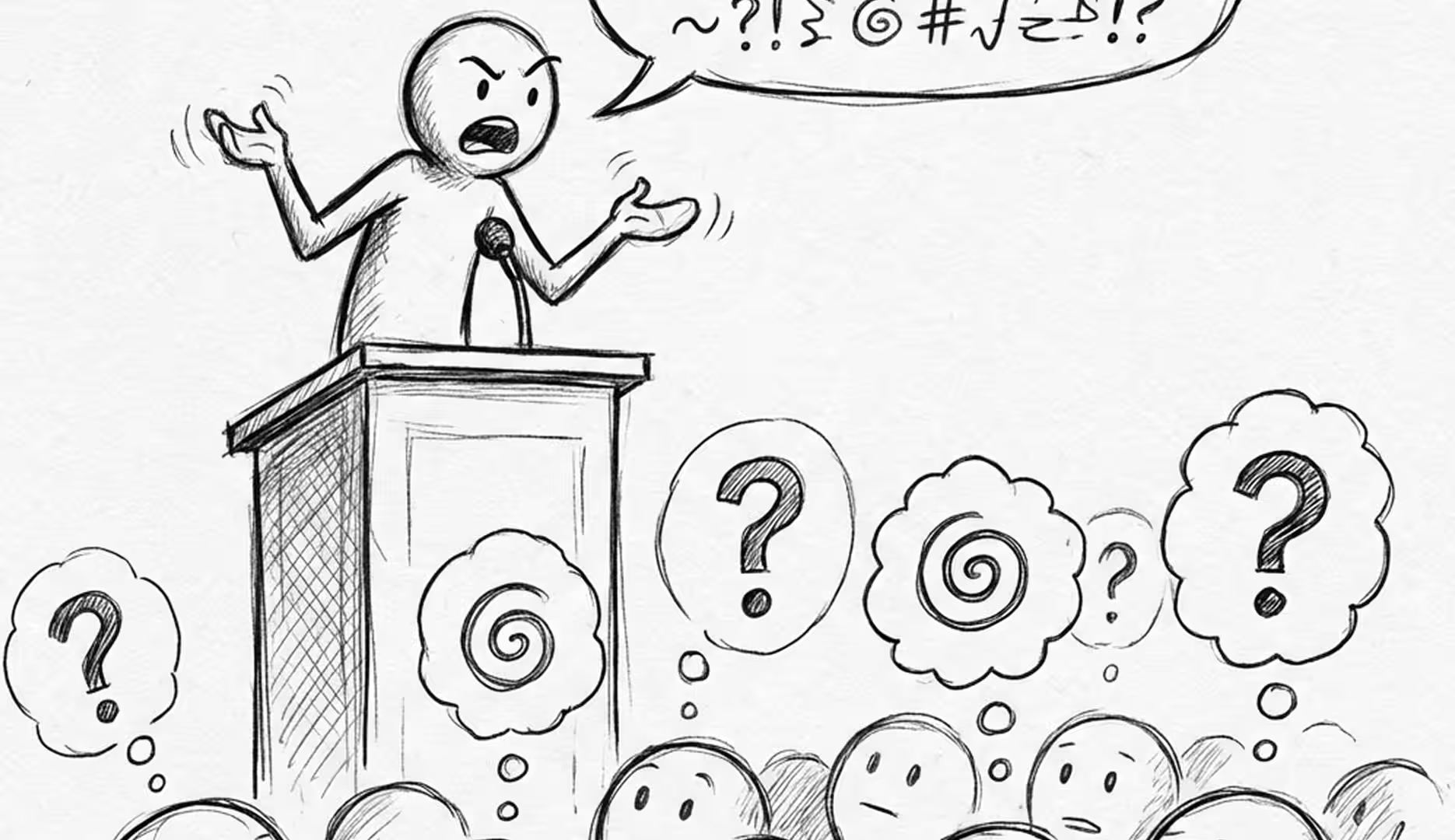
The problem: your clients do not speak that language.
An example. An IT service provider writes on their homepage: "We implement scalable cloud infrastructures for mid-sized companies." But the managing director looking for an IT partner googles: "solve IT problems in the company" or "server constantly slow what to do" or "IT firm that takes care of everything."
The gap is enormous. The company describes its solution. The client describes their problem. And these two languages never meet.
This has consequences on multiple levels. First: SEO. If nobody searches for the terms on your website, nobody finds you on Google. Second: clarity. If a visitor reads your homepage and does not immediately understand what you can do for them, they are gone within seconds. Third: trust. If a potential client feels like you are talking over their head, trust does not develop. Distance does.
The good news: you do not have to guess how your clients speak. You can find out systematically.
First: listen to your sales conversations. Not the presentations your sales team gives. But the questions clients ask. The words they use. The problems they describe. Usually the best website copy is sitting in the first five minutes of an initial conversation.
Second: read your own reviews. Google Reviews, Kununu, recommendations on LinkedIn. When clients talk about you, they use different words than you use yourself. And those are exactly the words that should be on your website.
Third: look at what your clients are googling. Tools like Google Search Console show you which search queries bring visitors to your site. Often these are terms that do not appear anywhere on your website.
Fourth: ask directly. In the next client conversation, the next feedback call: "How would you explain to someone who has never heard of us what we do for you?" The answer to that question is almost always better than any copy a marketing department has ever written.
The theory is simple. In practice, it helps to see concrete examples.
Before: "We offer holistic consulting services in the area of digital transformation." After: "We help companies that are struggling with outdated processes to digitize their workflows. Without bringing current operations to a standstill."
Before: "Our portfolio includes custom software solutions for various industries." After: "You have a problem for which there is no off-the-shelf software? We build the solution that fits your exact workflow."
Before: "Learn more about our services." After: "Let us discuss in 30 minutes whether we can help you."
The pattern is always the same: away from self-description, toward the client's perspective. Away from abstract terms, toward concrete situations. Away from "we can" toward "you get."
The call to action is the moment where your website is supposed to do its job. Someone has read your page, is interested, and should now take the next step. And then it says: "Learn more."
More about what? What happens if I click? Where does that take me?
CTAs fail when they are vague. And they work when they are concrete and tell the visitor what happens next.
"Learn more" becomes "All services at a glance." "Contact us" becomes "Write to us. We respond within 24 hours." "Get started" becomes "Book a free initial consultation (30 minutes)."
The difference is subtle but measurable. A CTA that describes what happens reduces the uncertainty around clicking. And less uncertainty means more clicks.
You do not have to rewrite every piece of copy on your website. The biggest leverage lies in a small amount of text in the right places.
The headline of your homepage. That is the first sentence visitors read. If it sounds like an internal memo, you lose a large portion of your visitors in the first three seconds.
Your service descriptions. Not the detailed subpages, but the summaries on the overview page. These are the texts that determine whether someone digs deeper or not.
Your CTAs. Every single button text on your website. These are often just three to five words per button. But they are the difference between a visitor who clicks and one who hesitates.
Your meta descriptions. The texts Google displays in search results. If they sound like jargon, nobody clicks on them, no matter how good your ranking is.
These four areas together make up perhaps 20% of the total copy on your website. But they have the greatest influence on whether a visitor stays, understands, and acts.
Review your website against these points: Does your homepage headline describe a concrete client problem or your own company? Would someone outside your industry understand within five seconds what you offer? Do your texts use the same terms your clients use in initial conversations? Are your CTAs concrete enough that the visitor knows what happens after clicking? Does your service page read like an answer to client questions or like an internal catalogue?
If you are uncertain about more than two points, there is a good chance your website copy is losing visitors who actually had interest.
In our archetype model, we distinguish four website types: client magnet, recruiting magnet, service portfolio, and investor pitch. Each archetype has not only a different structure, but also a different language logic.
A client magnet speaks the language of a client who has a problem and is looking for a solution. A recruiting magnet speaks the language of a candidate who is wondering whether this company is a fit. A service portfolio speaks the language of a decision-maker who wants to evaluate competence and experience. An investor pitch speaks the language of an investor who wants to understand market, traction, and scalability.
The copy on your website should not just be "well written". It should be written for the right audience. And that starts with understanding what job your website is currently supposed to do.
As CFO, Christian is responsible for the business side of Iridium Works. Over the years, he has built and managed several companies. Christian writes about digitalization, sales, and current market trends, and how Iridium's services impact its customers.
Access our exclusive whitepapers, expert webinars, and in-depth articles on the latest breakthroughs and strategic implications of webdesign, software development and AI.