
Christian Huff
CFO

Five pages are not enough if your website is meant to win clients. Here is how to build a content strategy that works with limited resources.
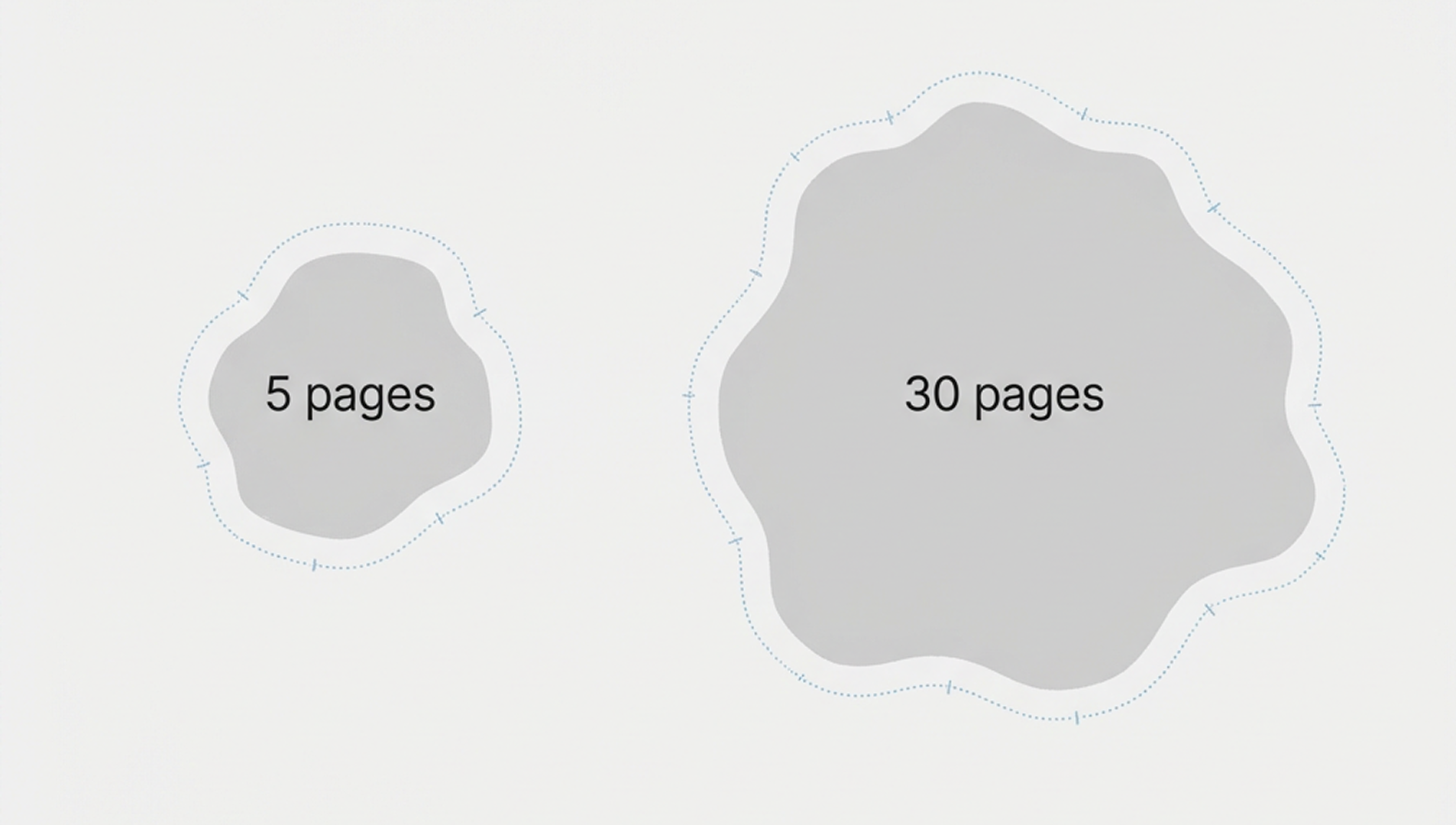
Five pages. Homepage, About, Services, References, Contact. That is the standard architecture of most business websites. It is tidy, clear, and feels complete.
But it is a digital business card. Not a sales tool.
The difference lies in content. Not in the sense of packing more text onto a page. But in the sense that every page on your website is an answer to a question. And potential clients have far more than five questions.
In almost every initial conversation we have with companies, the same pattern emerges: sales regularly answers the same questions. "What does that roughly cost?" "How does the collaboration work?" "What experience do you have in our industry?" "How long does a typical project take?"
These are the questions potential clients ask. Every day. On the phone, by email, in first conversations. And most of these questions appear nowhere on the website.
That is the content gap.
When your website does not answer these questions, two things happen. First, potential clients who type these questions into Google do not find you. They find someone else who has the answer on their website. Second, the prospects who do make it to your site arrive at the first conversation with more uncertainty. They do not know your answers. They do not know your stance. They do not know your competence.
Not all content is equal. And not every type of content fits every company. But there are formats that have proven themselves in our work again and again.
FAQ pages with real questions. Not the questions you would like to answer. The questions your clients actually ask. "What does a website cost?" is a FAQ. "Why do you use Webflow?" is too. The more specific, the better. Each individual question can have its own URL and rank on Google.
Blog articles with strategic focus. A blog that works answers questions your target audience has before they know they need a provider. If you build websites, write about website costs, about relaunch decisions, about content strategy. Not because it is fun, but because those are the topics your potential clients are googling.
Resource pages. Checklists, guides, frameworks. Content that is so useful someone saves it or shares it. This builds trust before the first conversation takes place.
Service pages with depth. "Web design" as one page is not enough. "Web design for B2B companies" is better. "Web design for mid-sized industrial companies" is even better. The more specific the page, the more relevant it is for the right audience.
The most common objection we hear: "We do not have the capacity for regular content." That is understandable. But it is a fallacy.
The alternative to content is not "no content". The alternative is: your sales team answers the same questions manually over and over. Your potential clients find your competitors instead of you. And your website remains a static brochure that helps no one make a decision.
Content is not an additional task. Content is sales work that is done once and continues to work indefinitely.
A realistic starting point looks like this: collect the ten most common questions your sales team answers. Write a dedicated page for each question. Not long, not perfect. But honest and helpful. That alone, in many cases, doubles the number of pages that can rank on Google.
Content is not an end in itself. It has to match the purpose of your website.
If your website is meant to be a client magnet, it needs content that builds trust and lowers barriers. FAQ pages, case studies, blog articles about the problems your target audience faces. If your website is meant to be a recruiting magnet, it needs content about company culture, everyday work life, and development opportunities. If your website is meant to be a service portfolio, it needs deep, specific service pages with real examples.
The question is not: do we need more content? The question is: which content do we need so that our website fulfills its purpose?
Nobody needs to write three blog articles per week. That is an expectation from the SEO world of the early 2010s and is unrealistic for most B2B companies.
A realistic content plan looks like this: one article per month that answers a real question your target audience has. Once per quarter, an update of the most important pages. And once per year, an honest review: which pages bring traffic? Which bring inquiries? Which can go?
More content is only better when it is relevant. Less content that answers the right questions always beats more content that nobody is searching for.
As CFO, Christian is responsible for the business side of Iridium Works. Over the years, he has built and managed several companies. Christian writes about digitalization, sales, and current market trends, and how Iridium's services impact its customers.
Access our exclusive whitepapers, expert webinars, and in-depth articles on the latest breakthroughs and strategic implications of webdesign, software development and AI.